



QUICK ANSWER A day at Tipai runs from first birdsong to the Milky Way. You wake in a 1,900 square foot forest villa, track tigers on a private morning safari, swim in a chemical-free bio-pool through the slow afternoon, and end with a seven-course open-fire dinner under a sky with no light pollution. Luxury here is space, privacy and time, not gloss.
Key takeaways
- The forest villa is the anchor: 1,900 square feet, a king bed with organic bedding, an open-to-the-sky shower, and a private sit-out where the day begins and ends.
- Two private safaris bookend the day, morning and evening, each in your own jeep with your own naturalist. No shared vehicles, no jeep jams.
- The rammed-earth walls keep the villa cool without air conditioning, so the luxury you feel at midday is silence, not a compressor humming.
- Dinner is a seven-course degustation at Palaash, cooked over open fire by Chef Amninder Sandhu’s all-women team, with produce picked ten feet away.
- Seclusion on 34 acres is the real premium. The day is yours to fill or to leave gloriously empty.
Before light: the forest wakes you, not an alarm

You do not need a wake-up call here. A little before six, the forest does it for you. A seasonal stream somewhere below the villa, the first francolin clearing its throat, cicadas winding down from the night shift. You pull back the blackout drapes and the wilderness is right there, close enough to touch, held back only by the glass.
Step onto your private sit-out with a cup of tea. The air is cool and smells of dew on dry teak. This is the first thing a luxury stay should give you and so rarely does: a morning that belongs entirely to you, on 34 acres where the nearest sound is a peacock and not another guest. Nobody is at the next table. There is no next table.
The villa behind you is 1,900 square feet of considered space. King bed, organic bedding, twin vanities, an open-to-the-sky shower where you can bathe with the canopy overhead. The luxury is in what is missing as much as what is present. No television demanding attention. No corridor noise. Just room to breathe.
6:00 AM: into the forest on a private jeep

The jeep meets you at the villa. Your naturalist is already reading the morning, a snapped twig, a line of fresh pugmarks, the direction of the breeze. Tipeshwar is compact, 148 square kilometres of dense teak and bamboo, and that works in your favour: a smaller forest with a growing tiger population means the territories overlap with the tracks you drive.
The difference you feel immediately is the quiet. This is a private safari, your jeep and no one else’s. When a sambar alarm call ripples through the trees and everyone falls silent, there are no twenty other engines idling, no cameras clattering on the next vehicle. If you want to wait twenty minutes at a waterhole on a hunch, you wait. The morning bends around your curiosity, not a fixed circuit.
No sighting is ever promised in a wild forest, and anyone who promises one is selling something. But the cool hours after dawn are when the big cats move, and Tipeshwar’s odds in the dry months are among the best in Maharashtra. (For the full picture of how a drive here unfolds, see the private safari guide.)
Mid-morning: breakfast you can taste the morning in

By ten the heat begins to press in and the jeep brings you back. Breakfast is at Perch, the all-day cafe with a bird’s-eye view over the wilderness you just drove through. Eggs cooked to order. Fruit harvested from the kitchen garden the same morning. Coffee brewed in front of you on the island bar. You eat slowly, because there is nowhere you need to be.
This is the rhythm the rest of the day follows. You move, then you pause. Nothing is rushed, and nothing is scheduled against your will.
The slow middle: the hours most resorts forget
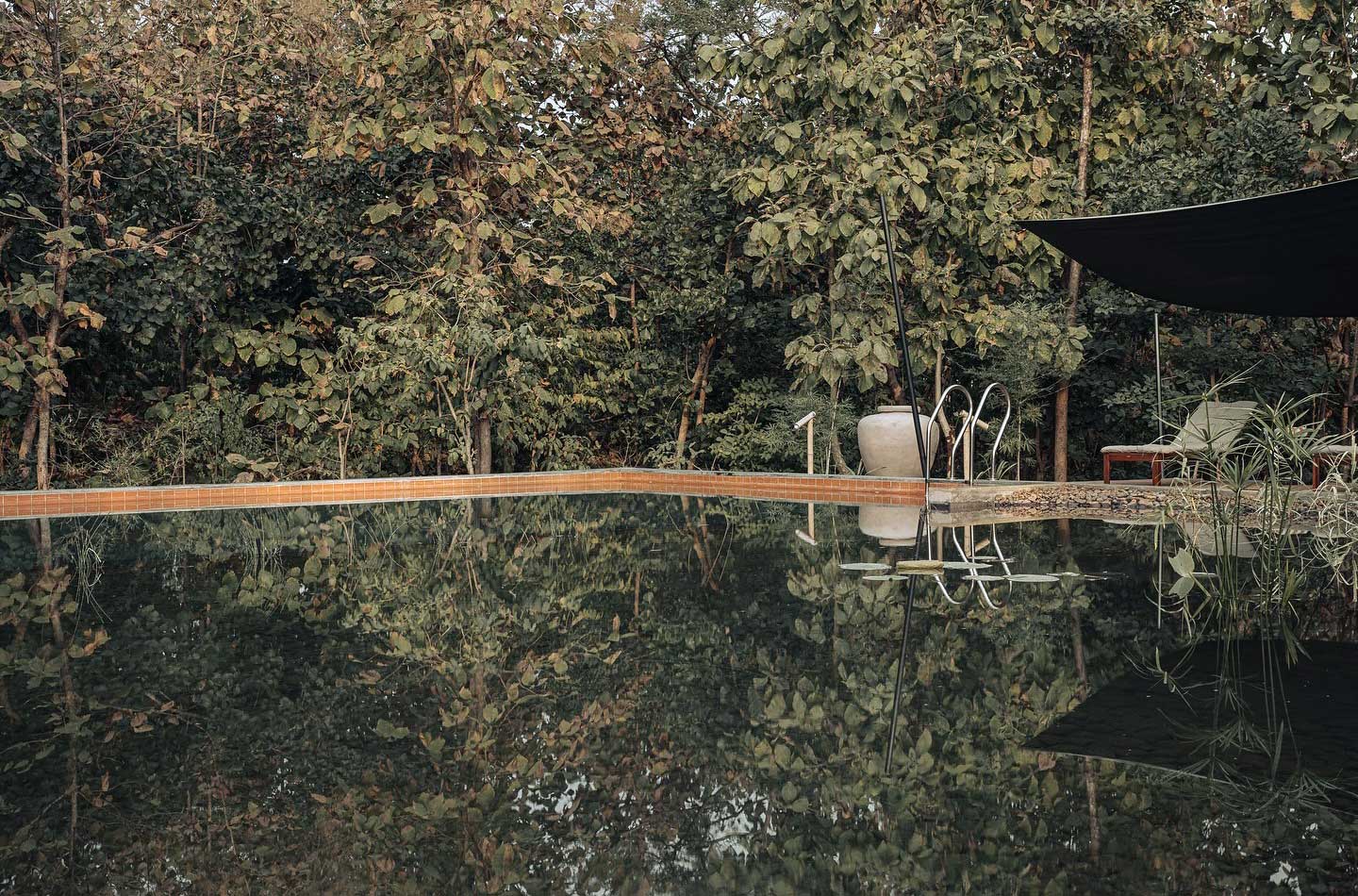
Most properties fill the afternoon with activities you did not ask for. Tipai does the opposite. It gives you a long, unhurried stretch and a handful of quiet ways to spend it.
The bio-pool. Slip into water that is filtered by plants and gravel rather than chlorine, so it is soft on the skin and asks for no chemical smell in return. It is luxury without the sting in your eyes, set against the tree line. (There is a whole piece on why a bio-pool beats a chlorine pool if you want the detail.)
The cool of the walls. Step back into the villa at the hottest point of the day and notice what is not happening. There is no air conditioning, and you do not miss it. The walls are rammed earth, 45 to 60 centimetres thick, and they hold the night’s coolness deep into the afternoon. The most luxurious room at Tipai stays comfortable on a 40 degree day through physics, not machinery. (We explain how the rammed-earth villas stay cool here.)
A walk through the food forest. Wander the permaculture garden that feeds the kitchens. Rows of herbs, fruit and vegetables, vines climbing the pillars at Wadi, the open-air garden kitchen. What you smell here at noon you will taste at dinner.
Or nothing at all. Fish at the lake. Read on the sit-out. Nap. The point of seclusion on 34 acres is that doing nothing feels like enough.
Golden hour: the second safari
At two the jeep returns and the forest changes character. The evening drive is warmer, softer, more contemplative. As the heat breaks, spotted deer gather at the waterholes, wild boar root through the undergrowth, and the predators begin to stir. The last light turns the teak amber and gold. This is the hour photographers wait all day for, and the hour a tiger crossing the track ahead of you feels almost cinematic.
Sundowners, then dinner cooked over open fire

Back at the resort, the day softens into evening. A sundowner at Mohro, the watering hole, where the cocktails are built around mahua and seasonal fruit grown by the neighbouring farming community. Then a bonfire as the sky empties of light.
Dinner is the day’s quiet crescendo. Palaash, set in a grove of the palaash trees that give it its name, is a dinner-only restaurant serving a seven-course degustation. It is cooked entirely over open fire by Chef Amninder Sandhu’s all-women team, in underground pits, on chulhas and sigris, in cast iron and bamboo and stone. No gas. The produce came from the garden ten feet away. The recipes carry Maharashtra, Madhya Pradesh and Andhra Pradesh in them. This is where the word luxury earns its keep: a chef rated among India’s best, cooking heirloom food in a clearing in a wildlife sanctuary, for a table that is yours.
If you would rather, the kitchen comes to you. Private dining on your villa’s deck, a la carte or a chef’s table, is part of the round-the-clock service.
After dark: the Milky Way, with nothing in the way
End on the stargazing deck. Out here, hours from the nearest city, there is no light pollution to wash the sky out. On a clear night the Milky Way is plainly visible, and a naturalist will help you trace the constellations the forest sleeps under. It is the simplest luxury of the lot, and the one a city cannot sell you at any price: a truly dark sky.
Then back to the villa. The walls have cooled again. The drapes draw against the dawn. Tomorrow the forest will wake you, and you will let it.
A day at Tipai, hour by hour
| Time | Where you are | What is happening |
|---|---|---|
| Before 6:00 AM | Villa sit-out | Tea, birdsong, the forest waking |
| 6:00 to 10:00 AM | Private jeep | Morning safari with your naturalist |
| 10:00 to 11:00 AM | Perch | Breakfast, eggs to order, garden fruit |
| 11:00 AM to 2:00 PM | Bio-pool, food forest, villa | The slow middle. Swim, walk, or rest |
| 2:00 to 6:00 PM | Private jeep | Evening safari through golden hour |
| 6:00 to 8:00 PM | Mohro, bonfire | Sundowners under an emptying sky |
| 8:00 PM onward | Palaash | Seven-course open-fire dinner |
| Late | Stargazing deck | The Milky Way, no light pollution |
Frequently asked questions
How big are the forest villas at Tipai?
Each forest villa is 1,900 square feet, with a king bed, organic bedding and blackout drapes, indoor and al fresco lounges, and a bath suite with an open-to-the-sky shower and twin vanities.
Do the villas have air conditioning?
The villas are built from rammed earth, with walls 45 to 60 centimetres thick that hold the night’s coolness through the day, so they stay comfortable without conventional air conditioning even in peak summer.
Is dining included, and can I eat in my villa?
Tipai offers private dining as a la carte, off-menu, or a chef’s table, alongside its restaurants. Round-the-clock service means the kitchen can come to your villa deck. Confirm what your specific package includes at the time of booking.
How many safaris can I do in a day?
Two, a morning drive and an evening drive, each in a private jeep with your own naturalist. The sanctuary is closed to visitors on Tuesdays.
Is there a swimming pool?
Yes, a bio-pool filtered naturally by plants and gravel rather than chlorine, so the water is soft and free of chemical odour.
How far is Tipai from the nearest city?
Tipai sits at the gateway of Tipeshwar Wildlife Sanctuary, roughly a 2.5 to 3 hour drive from Nagpur. Confirm current drive time and routes before you travel.





