



QUICK ANSWER The sloth bear is shaggy, insect-eating and famously unpredictable, and early mornings around fruiting trees are when Tipeshwar’s guides most often see one. Vulnerable on the IUCN Red List, it vacuums up termites through a gap where its front teeth should be, and mothers carry cubs on their backs to protect them from tigers and leopards.
Key Takeaways
- The sloth bear is assessed as Vulnerable on the IUCN Red List, with a falling population estimated at 10,000 to 20,000 individuals worldwide.
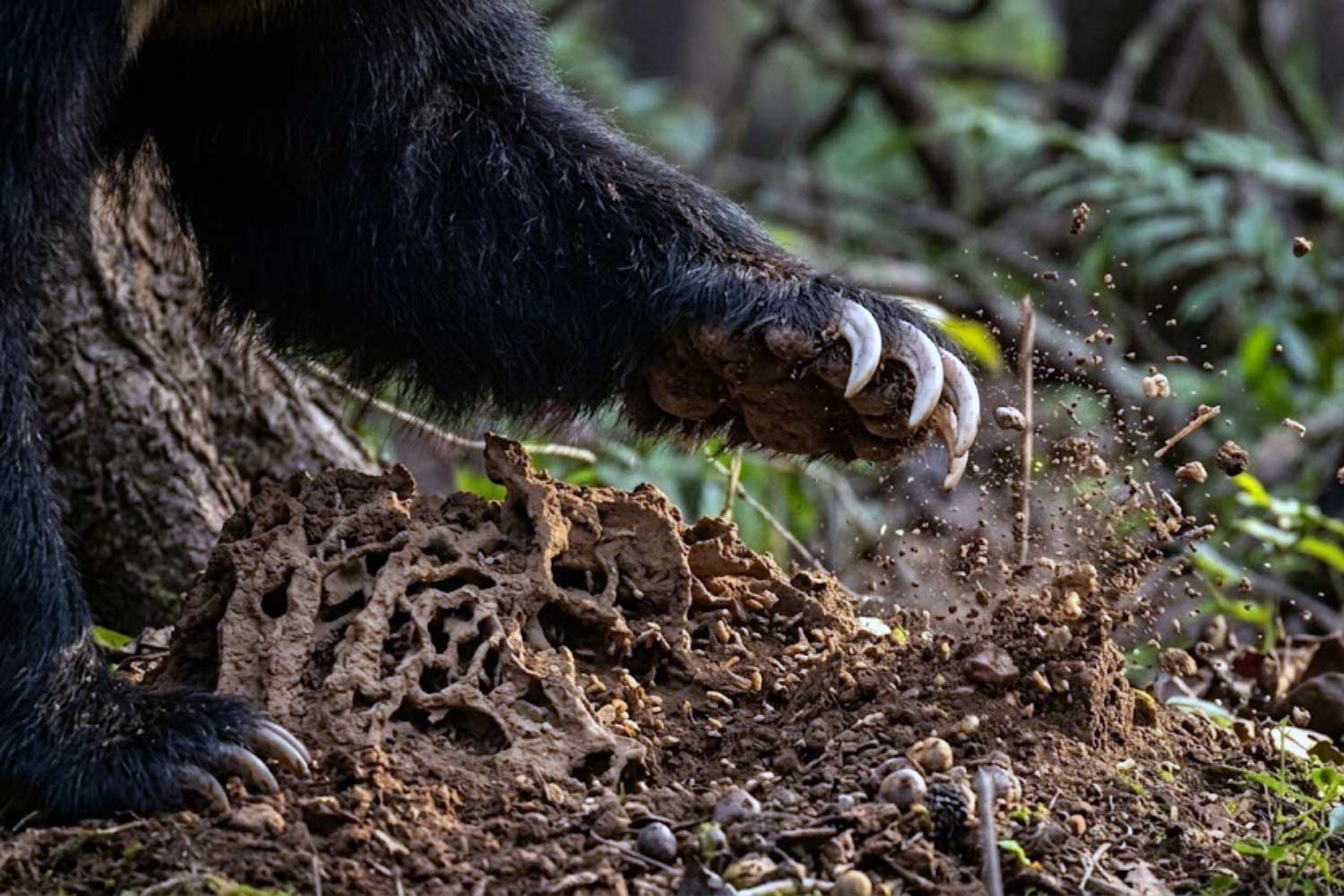
- It is a specialist termite and ant eater, with long claws, mobile lips and no upper middle incisors, and it feeds noisily enough to be heard before it is seen.
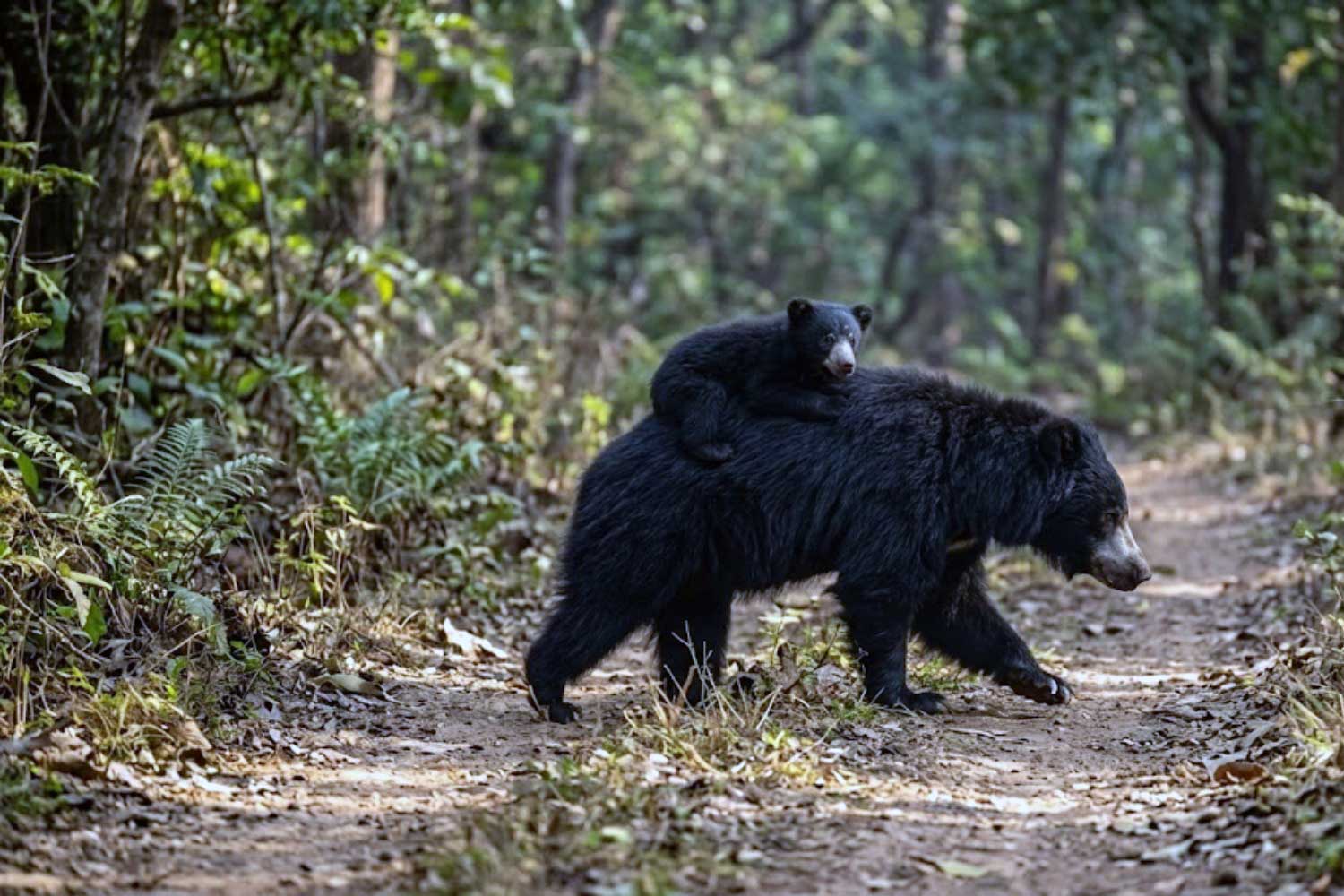
- Mothers carry their cubs on their backs for around nine months, which appears to be the cubs’ main defence against tigers and leopards.
- Fallen mahua flowers are a seasonal food, and mahua is one of the tree species recorded in Tipeshwar’s forest.
- The bear’s aggressive reputation is real at close range but partly unfair, since most trouble follows a startled encounter.
The Bear That Eats Like a Vacuum Cleaner
Ask a naturalist which animal surprises first-time guests most, and the answer is rarely the tiger. It is the sloth bear: shaggy, loud and utterly absorbed in its own business. Where the leopards of Tipeshwar are masters of not being noticed, the sloth bear does almost the opposite, snorting and sucking its way across a forest floor at dawn. It is the only bear species whose diet is built mainly on ants and termites, and the whole animal is engineered around that one job.
Watching one feed is unlike watching any other large mammal in the sanctuary. The sound comes first, a loud vacuum-like rasp as the bear draws insects out of a nest, and the sight follows.
Built for Termites
Every visible feature of a sloth bear is a tool. Understanding them turns a shaggy shape in the undergrowth into something you can read.
| Feature | What it does |
| Long, curved claws | Tear open termite mounds that can be rock-hard, and dig into the ground to reach ant colonies |
| Protruding, flexible lips and a broad palate | Form a seal for suction, so the bear can vacuum insects out of a nest |
| No upper middle incisors | Leaves a gap that lets air and insects pass through, unique among bears and the reason the suction works |
| Sparse hair on the muzzle | Thought to be an adaptation for coping with the defensive secretions termites release |
| Shaggy coat, no underfur, long hair around the neck and ears | The unmistakable outline, with a pale V or Y marking on the chest |
Take away any one of these adaptations and the strategy fails. It is a rare case where an animal’s odd appearance and its daily behaviour are the same story.

Why the Mahua Tree Matters
Sloth bears are not only insect eaters. They are seasonal opportunists, feeding on forest fruits, the pods of the Indian laburnum, and the fallen flowers of the mahua tree. Mahua is among the species recorded in Tipeshwar’s forest, alongside teak and others, and a flowering mahua can pull a bear reliably to the same spot. It is also why guides watch fruiting trees at first light, when Tipeshwar’s own winter safari guidance notes sloth bears are most active.
Mahua has a second role in the landscape. It is a prized minor forest product, and flowers are widely collected by villagers across central India. When bears and people want the same trees at the same hour, conflict follows, which is one reason the species’ future depends as much on the villages around a sanctuary as on the sanctuary itself.
A Bear That Carries Its Cubs
Sloth bear mothers do something no other bear does routinely: they carry their cubs on their backs. Litters are usually two cubs, occasionally three, born between September and November in a protected den where the mother may barely leave for two or three months. Once they emerge, the cubs ride on her back until they are around nine months old, and researchers believe this is the main defence against tigers and leopards, the only large predators that seriously threaten the species.
The cubs stay with their mother for a year and a half to two years, leaving shortly before the next breeding season, which falls in the hot months of May to July. A mother with cubs is a very different animal from a lone adult, more cautious, more likely to be active in daylight to avoid nocturnal predators, and far less tolerant of anything that gets close.
Unpredictable, and Sometimes Unfairly So
The reputation is earned, but it needs context. Sloth bears are solitary and largely nocturnal, and they feed so noisily that a bear absorbed in a termite mound may not register an approaching person until the last moment. A startled bear at close range can charge, and central India’s records of serious injuries to people involve sloth bears more often than most visitors expect. Reference works are careful to note, though, that the fierce image may be partly an unfair description, since so many incidents trace back to a surprise encounter rather than deliberate aggression.
On a safari, the practical answer is simple and is the same as everything covered in our piece on ethical wildlife watching: stay seated inside the vehicle, stay quiet, and let the naturalist judge distance. A bear seen from a jeep at a sensible range is neither a danger nor a disappointment. It is one of the most entertaining sightings in the forest.
A Vulnerable Species
The sloth bear is easy to overlook in conservation conversations because it is neither a tiger nor a rarity, but its position is less secure than its shaggy good humour suggests.
| Pressure | What it means for the bear |
| Habitat loss and fragmentation | Farming, logging, mining and building break up the forest a solitary, wide-ranging animal depends on |
| Retaliatory killing and poisoning | Documented particularly during the season when villagers collect minor forest produce and bears and people share the same trees |
| A history of exploitation | Sloth bears were once captured and forced to perform as so-called dancing bears, a practice that rescue organisations have worked for decades to end |
| Declining numbers across the range | The IUCN assesses the species as Vulnerable, with an estimated 10,000 to 20,000 individuals worldwide and a falling trend |
Sloth bears also do useful work. They keep termite populations in check and disperse the seeds of the fruit they eat, quietly shaping the forest around them.

Improving Your Odds at Tipeshwar
Guides at Tipeshwar point to early mornings, particularly around fruiting trees, as the time sloth bears are most often seen. That favours a private safari that can be at the right stretch of forest at first light and hold still once a bear is found, since a bear feeding at a mound will often keep feeding for a long time if it is not disturbed. Patience and quiet do more here than any amount of driving.
Frequently Asked Questions
Are sloth bears dangerous?
They can be at close range, particularly when startled, and central India records serious injuries involving them. From a safari vehicle at a proper distance they pose no danger, and much of their fierce reputation traces back to surprise encounters.
What do sloth bears eat?
Mainly ants and termites, supplemented seasonally by fruit, honey, pods and fallen mahua flowers. They use their claws to open mounds and suck the insects out through a gap in their upper teeth.
Why do sloth bear cubs ride on their mothers’ backs?
Researchers believe it is the cubs’ main defence against tigers and leopards. Cubs are typically carried from the time they leave the den until they are around nine months old.
Are sloth bears endangered?
They are classed as Vulnerable on the IUCN Red List, with a declining population estimated at 10,000 to 20,000 individuals worldwide.
When is the best time to see a sloth bear at Tipeshwar?
Early mornings, especially around fruiting trees, according to the sanctuary’s winter safari guidance. No sighting can be guaranteed.





