



QUICK ANSWER Safari overcrowding, jeeps converging on a single sighting within minutes of a tip-off, has become serious enough that the Supreme Court of India introduced new tiger reserve restrictions in November 2025, and individual reserves like Ranthambore and Pench have faced viral incidents and legal action since. The problem is structural: parks with high vehicle volume and phone-coordinated tip-offs create jams almost by design. Parks with naturally low vehicle counts, like Tipeshwar, avoid the problem at the source rather than policing it after the fact.
Key Takeaways
- Safari jeep crowding is now a nationally recognised problem, not an occasional bad-luck story, serious enough to trigger Supreme Court intervention in November 2025.
- A December 2024 incident at Pench Tiger Reserve, near Nagpur, saw a tigress and her five cubs surrounded by vehicles, resulting in suspensions and fines under the Wildlife Protection Act.
- A February 2026 viral video from Ranthambore’s Mishri Darra gate showed a tiger encircled by jeeps despite a phone ban that had already been in place for three weeks, exposing a real gap between rules and enforcement.
- The core mechanism is simple: guides share sighting coordinates by phone, and ten or more vehicles can converge on one spot within minutes.
- Structurally low-volume parks avoid this problem by design rather than needing to police it after the fact.
A Problem With a Name Now
Safari overcrowding used to be the kind of complaint travellers swapped quietly after a trip, a jeep jam nobody photographed and nobody reported. That changed in 2026. A single video from Ranthambore’s Mishri Darra gate, showing a tiger growling while surrounded by a tight ring of jeeps, went viral and forced the issue into the open. For anyone weighing up a comparison of central India’s tiger parks before booking, crowding has become as important a factor as tiger density or access time, and arguably more predictable.
What made the Ranthambore video sting particularly hard was timing. The park had formally banned mobile phones on safari just three weeks earlier, on January 30, 2026. The ban did not stop the jam. That gap, between a rule on paper and what actually happens on a forest track, is the real story here.
How a Jam Actually Forms
The mechanism behind a safari jam is almost embarrassingly simple. A guide spots a tiger, radios or messages other guides with the location, and within minutes every vehicle within range converges on the same spot. It is efficient in the way a flash mob is efficient, and just as disruptive to whatever it surrounds. Advocates pushing for stronger reform have called for measures well beyond a phone ban: mobile signal suppression inside core zones, mandatory ethics declarations for guides, hard caps on vehicles per sighting, and real penalties when those caps are ignored.
This Is Not Just a Ranthambore Problem
The Mishri Darra video got the most attention because it was filmed and shared widely, but it was not an isolated incident, and it was not even the first serious case. On December 31, 2024, a tigress known as F-2 and her five cubs were surrounded by a crowd of vehicles in the buffer zone near Gothangaon in Pench Tiger Reserve, a park in Tipeshwar’s own Maharashtra comparison set and barely two hours from Nagpur. The Bombay High Court took suo motu notice of the incident. Four drivers and guides were suspended for three months, with fines issued under the Wildlife Protection Act.
| When | What happened |
| December 31, 2024 – Pench Tiger Reserve | A tigress and her five cubs were surrounded by a crowd of vehicles in the buffer zone near Gothangaon. Bombay High Court took suo motu notice; four drivers and guides were suspended for three months and fined under the Wildlife Protection Act. |
| November 2025 – Supreme Court of India | A ruling introduced sweeping restrictions across India’s tiger reserves: mobile phone restrictions on safari, an end to night safaris in core zones, and limits on development along reserve boundaries. |
| January 30, 2026 – Ranthambore | Formally banned mobile phone use during safaris, among the first reserves to act on the new restrictions. |
| February 2026 – Ranthambore, Mishri Darra Gate | A video showing a tiger growling while surrounded by a ring of jeeps went viral, despite the phone ban already being three weeks old, exposing a real enforcement gap. |
Two different parks, two different states, the same underlying failure: too many vehicles with too little friction converging on too few animals.

The Supreme Court Steps In
In November 2025, the Supreme Court of India issued a ruling with real teeth for tiger reserves nationwide: restrictions on mobile phone use during safaris, an end to night safaris within core zones, and limits on further development along reserve boundaries. The directions took effect in April 2026, and individual reserves have moved at different speeds to implement them, Ranthambore’s January phone ban being one of the earlier examples. Enforcement, as the Mishri Darra video demonstrated, remains the harder half of the problem.
Why Some Parks Never Have This Problem
Rules can be written for any park. Low vehicle volume has to be built in from the start. A reserve drawing hundreds of thousands of annual visitors, split across a handful of zones, will always face pressure toward exactly this kind of jam, no matter how strict the rulebook gets. Tipeshwar’s structure avoids the problem at its source: a small sanctuary, no zone lottery concentrating everyone toward the same hot spot, and a daily vehicle count low enough that a tip-off has nowhere to send a crowd. It is not a policy achieved through enforcement. It is a consequence of the park’s own size and how few vehicles operate within it on any given morning.
What This Means for Choosing a Park
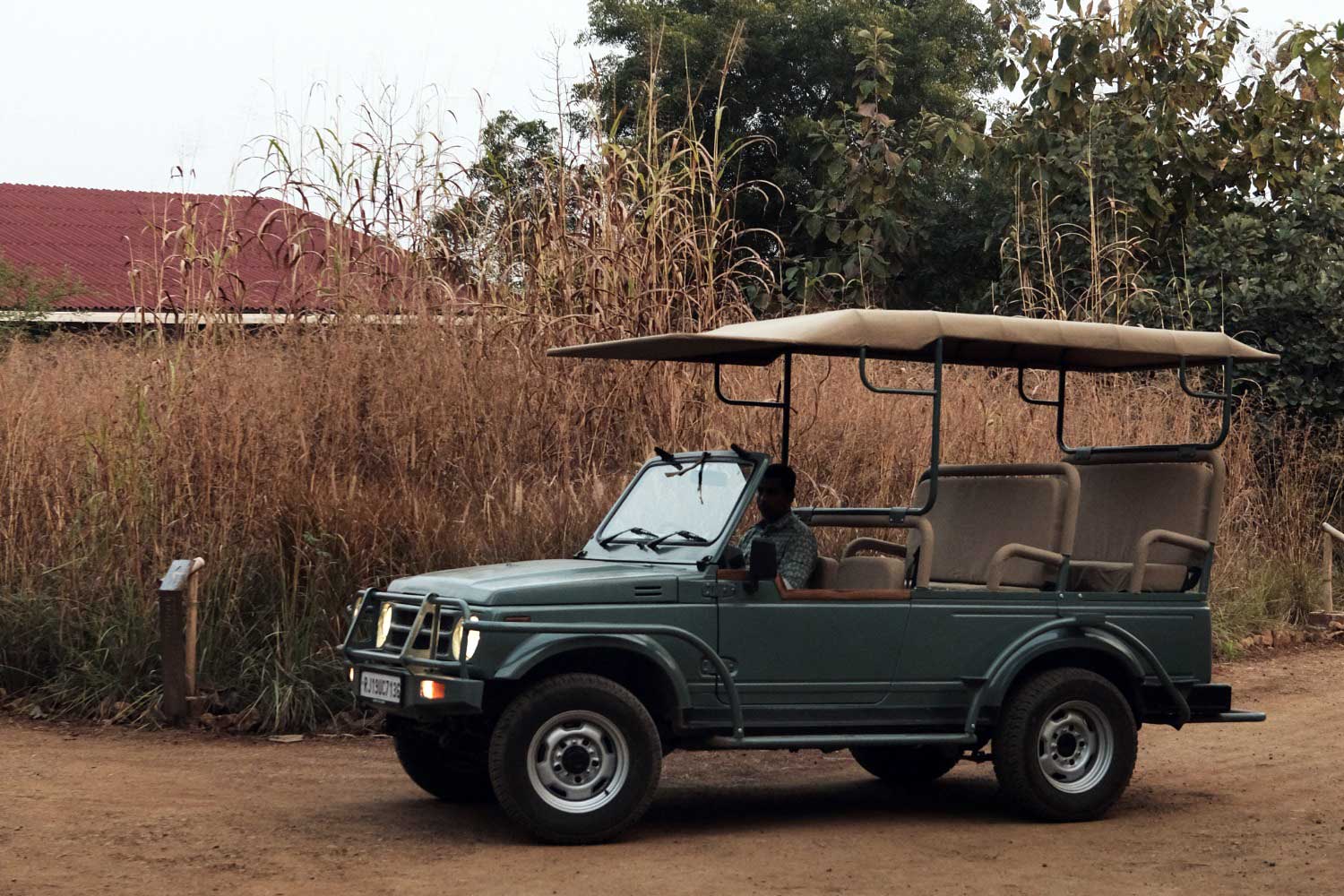
A crowded safari is not bad luck. It is usually a predictable outcome of a park’s own structure, its vehicle volume, its zone system, how tightly sightings cluster in a small area. Before booking, it is worth asking a version of the question regulators are only now asking formally: how many vehicles does this park actually put into the forest at once, and what happens when all of them hear about the same tiger within the same five minutes. Choosing a private safari removes the incentive to chase a crowd in the first place, since there’s no group pressure pushing toward someone else’s sighting.
Frequently Asked Questions
What caused the Ranthambore safari jam video to go viral?
A February 2026 video from the Mishri Darra gate showed a tiger surrounded by a tight ring of jeeps, despite a mobile phone ban that had already been in place for three weeks, highlighting a gap between rules and real enforcement.
What happened at Pench Tiger Reserve in December 2024?
A tigress known as F-2 and her five cubs were surrounded by vehicles in the buffer zone near Gothangaon. The Bombay High Court took suo motu notice, and four drivers and guides were suspended for three months with fines issued under the Wildlife Protection Act.
What did the Supreme Court rule in November 2025?
The ruling introduced restrictions on mobile phone use during safaris, ended night safaris in core zones, and limited further development along tiger reserve boundaries, with the directions taking effect in April 2026.
How can I avoid a crowded safari experience?
Choose a park with naturally low daily vehicle volume and no zone lottery system concentrating visitors toward the same sightings, and consider a private safari, which removes the incentive to chase a crowd in the first place.
Are mobile phone bans actually working?
Enforcement has been inconsistent so far. Ranthambore’s ban was already three weeks old when the viral Mishri Darra incident occurred, suggesting rules alone are not sufficient without consistent on-ground enforcement.





